

Quantum Computing: Unlocking the Future of Technology
Introduction
Over the last few decades, technology has evolved at an unprecedented pace. From classical computers that filled entire rooms to smartphones that fit in our pockets, the journey of computing has been nothing short of revolutionary. But as we enter the mid-21st century, a new frontier is emerging that promises to redefine everything we know about computing — Quantum Computing.
Quantum computing is not just an upgrade to classical computers; it is a completely different paradigm. By leveraging the principles of quantum mechanics — the branch of physics that studies the behavior of particles at the smallest scales — quantum computers can solve problems that would take today’s supercomputers millions of years.
In this blog, we’ll take a deep dive into the world of quantum computing, exploring what it is, how it works, its applications, challenges, and what the future holds.
1. What is Quantum Computing?
Quantum computing is a field of computer science that uses the principles of quantum mechanics to proce
ss information. Unlike classical computers, which rely on bits (0s and 1s), quantum computers use qubits.
- Bits vs Qubits:
A classical bit can only be 0 or 1 at a time. In contrast, a qubit can be 0, 1, or both at the same time due to a property called superposition. This means a quantum computer can perform many calculations simultaneously. - Superposition:
Think of spinning a coin in the air. While spinning, it’s both heads and tails until it lands. That’s how a qubit behaves in superposition. - Entanglement:
Another quantum property is entanglement, where two qubits become linked. Changing the state of one qubit instantly affects the other, no matter how far apart they are. This enables quantum computers to process complex relationships between data at an incredible speed. - Quantum Interference:
Quantum systems can amplify correct answers and cancel out wrong ones using interference. This enables quantum computers to find the correct solutions more efficiently.
2. The Difference Between Classical and Quantum Computing
To truly appreciate quantum computing, it’s important to contrast it with classical computing.
Classical Computers:
- Operate on binary logic (0s and 1s).
- Follow deterministic algorithms step by step.
- Ideal for everyday tasks like word processing, web browsing, or simple data analysis.
Quantum Computers:
- Operate on qubits with superposition and entanglement.
- Perform massive parallel computations.
- Suitable for problems that classical computers cannot solve in a reasonable time, such as cryptography, drug discovery, optimization, and simulation of quantum systems.
In short, while classical computers are general-purpose and reliable, quantum computers are specialized machines designed to solve extremely complex problems.
3. A Brief History of Quantum Computing
Quantum computing may sound futuristic, but its origins date back to the 1980s.
- 1981: Physicist Richard Feynman suggested that classical computers struggle to simulate quantum systems, and only a quantum system could efficiently model them.
- 1985: David Deutsch proposed the idea of a universal quantum computer.
- 1994: Peter Shor developed a quantum algorithm for factoring large numbers, which posed a threat to classical encryption methods.
- 2001: IBM demonstrated a 7-qubit quantum computer that successfully executed Shor’s algorithm on small numbers.
- 2019: Google announced “quantum supremacy” after its Sycamore quantum computer solved a problem in 200 seconds that would take the world’s fastest supercomputer 10,000 years.
Since then, companies such as IBM, Google, Microsoft, Rigetti, and numerous startups worldwide have accelerated quantum research, moving us closer to the development of practical, large-scale quantum computers.
4. How Does a Quantum Computer Work?

Building a quantum computer is extremely challenging because qubits are very sensitive to their environment. Here’s how they function:
- Physical Qubits:
Qubits can be created using trapped ions, superconducting circuits, photons, or even atoms. Each approach has advantages and limitations. - Quantum Gates:
Just like classical computers use logic gates, quantum computers use quantum gates to manipulate qubits. These gates change the qubit’s state while preserving quantum properties. - Quantum Circuits:
Quantum gates are combined into circuits to perform calculations. - Measurement:
When a quantum computation finishes, the qubits are measured. Superposition collapses, and the result is read as classical bits. - Error Correction:
One of the biggest challenges is quantum decoherence, where qubits lose information due to noise. Scientists are developing quantum error correction codes to solve this.
5. Applications of Quantum Computing
Quantum computing has the potential to revolutionize multiple industries. Let’s explore the most promising areas:
- Cryptography and Cybersecurity
Classical encryption relies on factoring large prime numbers, which is practically impossible for traditional computers. Quantum computers can break these encryptions using Shor’s algorithm, forcing the development of post-quantum cryptography.
- Drug Discovery and Healthcare
Simulating molecules is extremely difficult with classical computers. Quantum computers can model chemical interactions at the quantum level, accelerating the discovery of new drugs, vaccines, and materials.
- Artificial Intelligence and Machine Learning
Quantum computing can enhance AI by speeding up optimization problems and improving pattern recognition in massive datasets. Quantum Machine Learning (QML) is already an emerging field.
- Financial Modeling
Banks and investment firms can use quantum algorithms to analyze risks, optimize portfolios, and simulate complex markets.
- Climate and Weather Prediction
Quantum computers can simulate complex natural systems, leading to better climate models and more accurate weather forecasting.
- Optimization Problems
From supply chain logistics to traffic flow management, quantum computers can optimize resources and processes at scales classical computers cannot match.
- Material Science
Quantum simulations can help design superconductors, advanced batteries, and other revolutionary materials.
6. Current State of Quantum Computing
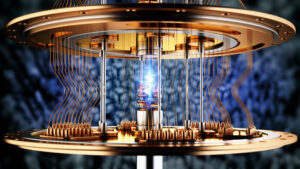
While the potential is enormous, practical quantum computing is still in its early stages.
- Noisy Intermediate-Scale Quantum (NISQ) Era:
We are currently in the NISQ stage, where quantum computers with 50–100 qubits exist but are prone to errors. They can’t yet outperform classical supercomputers for most real-world tasks. - Cloud Quantum Computing:
Companies like IBM and Microsoft offer cloud-based access to quantum computers, allowing researchers and developers worldwide to experiment with quantum algorithms. - Hybrid Approaches:
Combining classical and quantum computing (hybrid systems) is becoming a practical way to solve problems. Classical systems handle general tasks, while quantum processors tackle specialized challenges.
7. Challenges in Quantum Computing
Despite the excitement, quantum computing faces major challenges:
- Decoherence and Noise:
Qubits are highly unstable and can lose information quickly. - Error Correction:
Quantum error correction requires multiple qubits to safeguard one logical qubit, making large-scale systems complex. - Scalability:
Building millions of qubits for practical applications remains a huge engineering challenge. - High Costs:
Quantum computers require extreme environments (ultra-low temperatures or vacuum systems), making them very expensive. - Algorithm Development:Only a handful of algorithms exist that can truly take advantage of quantum computing.
- Security Concerns:
Once powerful enough, quantum computers could break existing encryption, raising cybersecurity concerns.
8. The Future of Quantum Computing

Despite challenges, progress is accelerating. Experts predict several key trends:
- Quantum Advantage by 2030:
By the next decade, quantum computers may solve problems that classical computers cannot, marking true quantum advantage. - Post-Quantum Cryptography:
Governments and tech companies are already working on new encryption methods resistant to quantum attacks. - Quantum Cloud Services:
Just like cloud computing today, quantum computing may be offered as a service, allowing businesses to rent quantum power on demand. - Industry Adoption:
Healthcare, finance, logistics, and energy will likely be the first industries to adopt quantum computing solutions. - Integration with AI:
Quantum-enhanced AI could unlock breakthroughs in automation, natural language processing, and decision-making. - Global Race:
Countries like the USA, China, India, and members of the EU are investing billions in quantum research, sparking a global race for quantum supremacy.
9. Ethical and Societal Implications
With great power comes great responsibility. Quantum computing brings ethical questions, too:
- Data Privacy: Quantum decryption could expose sensitive information.
- Digital Inequality: Nations or corporations with quantum advantage may dominate others.
- Job Disruption: As quantum-powered AI evolves, it could displace jobs in certain industries.
- Military Use: Quantum technologies may play a role in future warfare and surveillance.
Society must prepare regulations and ethical frameworks to ensure quantum technology benefits humanity as a whole.
Conclusion
Quantum computing represents one of the most exciting frontiers of modern science and technology. While classical computers will continue to play a vital role in everyday tasks, quantum computing will push the boundaries of what is computationally possible.
From revolutionizing healthcare and finance to reshaping AI and cybersecurity, the applications are endless. Yet, the path ahead is filled with challenges — technical, financial, and ethical. The world is still in the early stages, but the pace of progress suggests that within a few decades, quantum computing could become as indispensable as classical computing is today.
As Richard Feynman once said, “Nature isn’t classical, dammit, and if you want to make a simulation of nature, you’d better make it quantum mechanical.” Quantum computing, in many ways, is humanity’s attempt to understand and harness the deepest laws of nature.
The quantum future is not just near — it has already begun.





Leave a Reply